




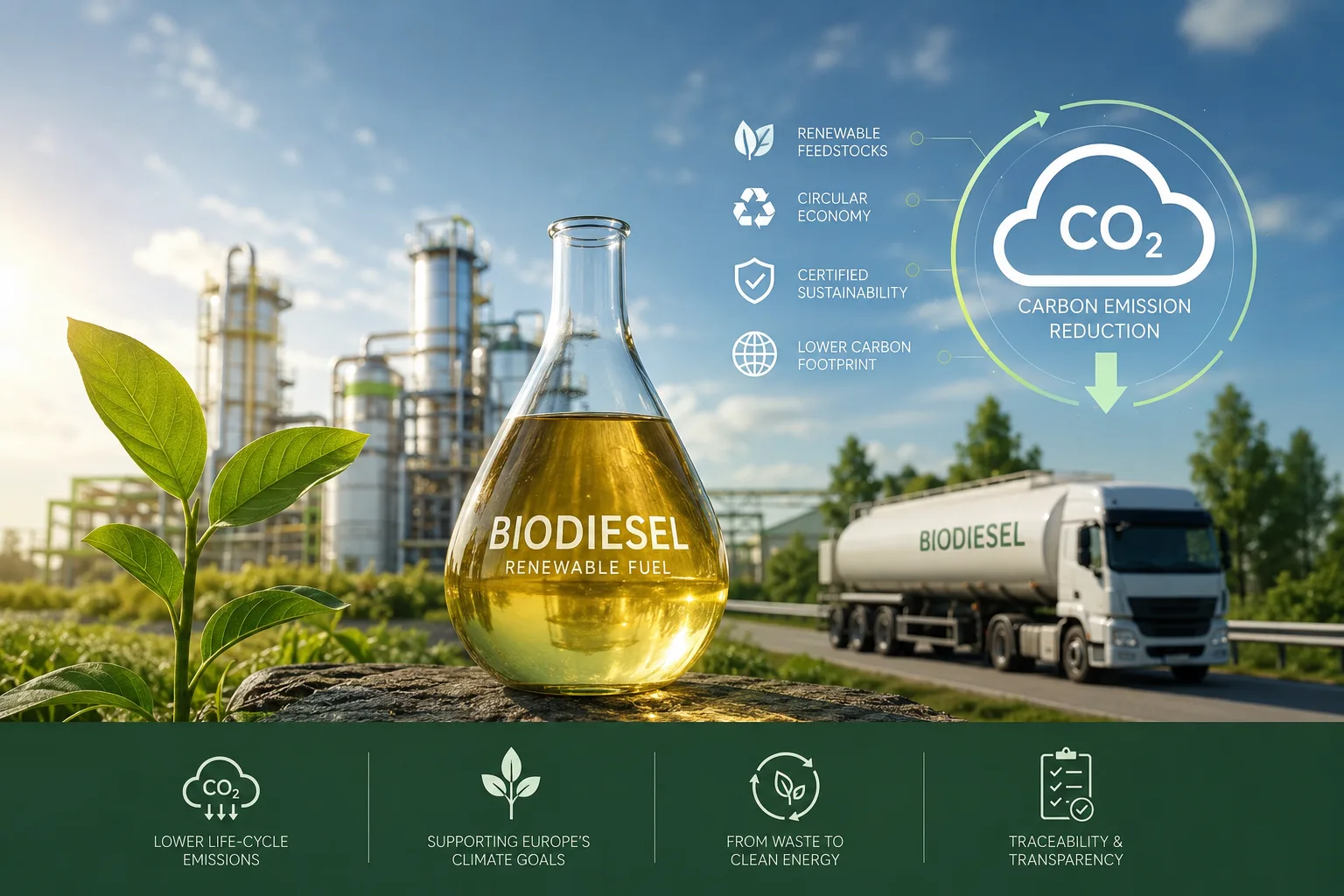
Biodiesel Carbon Emission Reduction: How Sustainable Production Helps Lower Greenhouse Gas Emissions
Table of Contents
- Introduction
- Why Biodiesel Carbon Emission Reduction Matters
- How Biodiesel Supports Lower Greenhouse Gas Emissions
- Why Traceability Is Essential
- Sustainable Feedstocks and Circular Economy
- ISCC EU Certification
- Kanola Biofuels B.V.’s Production Approach
- Digital Traceability
- Future of Renewable Transport Fuels
- Frequently Asked Questions
- Conclusion
Introduction
Biodiesel carbon emission reduction has become one of the most important topics in today’s renewable energy transition. Governments, transport companies, industrial organizations and fuel suppliers are all working toward reducing greenhouse gas emissions while maintaining reliable energy supplies. Renewable liquid fuels such as biodiesel continue to play an important role in this transition because they can support lower life-cycle emissions when produced from eligible feedstocks under recognized sustainability standards.
At Kanola Biofuels B.V., sustainability is not viewed as a marketing claim. It is supported through documented production procedures, certified management systems, traceable feedstock sourcing and transparent operational practices. Every stage of the production process is designed to improve traceability, maintain compliance with European sustainability requirements and support responsible renewable fuel production.
Reducing greenhouse gas emissions requires more than simply replacing fossil fuels. It requires responsible sourcing, accurate documentation, controlled manufacturing processes and continuous monitoring throughout the supply chain. These elements work together to ensure that sustainability claims are supported by verifiable information rather than assumptions.
This article explains how biodiesel contributes to carbon emission reduction, why traceability is essential, how sustainability certification supports transparency and how Kanola Biofuels B.V. applies these principles throughout its production operations.
Why Biodiesel Carbon Emission Reduction Matters
Climate change continues to influence environmental policy across Europe and around the world. One of the primary objectives of European renewable energy legislation is reducing greenhouse gas emissions from transport while increasing the share of renewable energy sources within the overall energy mix.
Road transportation remains heavily dependent on conventional fossil diesel. While electrification is expanding, many commercial vehicles, logistics operations, marine applications and industrial sectors continue to rely on liquid fuels. Biodiesel provides an opportunity to reduce the environmental impact of these sectors without requiring immediate replacement of existing infrastructure.
Unlike fossil diesel, biodiesel can be produced from renewable biological resources. When eligible waste- and residue-based feedstocks are processed through documented production systems, biodiesel may contribute to lower life-cycle greenhouse gas emissions compared with conventional fossil fuels. The actual emission performance depends on multiple factors, including feedstock origin, transportation, production efficiency and supply-chain documentation.
Because of these variables, carbon emission reduction should always be evaluated using recognized life-cycle assessment methodologies rather than relying on general assumptions about renewable fuels.
How Biodiesel Supports Lower Greenhouse Gas Emissions
The environmental benefit of biodiesel is measured across its entire life cycle rather than only during combustion. This approach considers emissions associated with collecting feedstocks, transporting raw materials, processing them into biodiesel, storing finished products and delivering them to customers.
Several operational factors influence greenhouse gas performance:
- Feedstock selection
- Transportation distances
- Production efficiency
- Energy consumption during manufacturing
- Storage conditions
- Supply-chain traceability
- Sustainability documentation
- Regulatory compliance
Each of these factors contributes to the overall greenhouse gas profile of the final product.
For this reason, modern biodiesel production focuses not only on manufacturing efficiency but also on maintaining transparent documentation throughout every stage of production.
Kanola Biofuels B.V. supports this objective through structured production procedures, operational controls and digital documentation systems that improve supply-chain transparency and product traceability.
Why Traceability Is Essential
Traceability is one of the most important principles within sustainable biodiesel production.
Every incoming feedstock should be connected to production records, sustainability documentation and outgoing product batches through documented operational procedures.
Without effective traceability, sustainability claims become difficult to verify.
Modern traceability systems help companies:
- identify material origins,
- document supplier information,
- monitor production batches,
- maintain chain-of-custody records,
- support sustainability audits,
- improve regulatory transparency,
- strengthen customer confidence.
At Kanola Biofuels B.V., traceability supports both operational efficiency and regulatory compliance by ensuring that production records remain transparent and verifiable throughout the supply chain.
Sustainable Feedstocks and Circular Economy
One of the most important factors influencing biodiesel carbon emission reduction is the selection of appropriate feedstocks. The environmental performance of biodiesel is not determined solely by the final fuel itself but also by the origin, handling and documentation of the raw materials used during production.
Waste- and residue-based feedstocks play a significant role in Europe’s transition towards a more circular economy. Instead of allowing eligible residual materials to remain unused, these resources can be recovered and processed into renewable transport fuels under controlled production conditions.
The circular economy aims to maximize the value of existing resources by extending their useful life and reducing unnecessary waste. Within the renewable fuel sector, this approach supports more efficient resource utilization while helping reduce dependence on finite fossil resources.
At Kanola Biofuels B.V., eligible feedstocks are processed through documented operational procedures designed to support transparency, traceability and regulatory compliance throughout the production process.
It is important to note that not every secondary material automatically qualifies as a waste or residue feedstock. Material classification depends on applicable legislation, supplier documentation and sustainability requirements. Proper verification helps ensure that renewable fuel claims are supported by reliable and auditable information.
ISCC EU Certification
Producing renewable fuel is only one part of responsible biodiesel manufacturing. Demonstrating that sustainability claims are supported by documented processes is equally important.
Certification systems provide an independent framework for verifying production activities, traceability and sustainability documentation. These systems help customers, regulators and business partners evaluate whether renewable fuel production follows recognized operational standards.
Kanola Biofuels B.V. operates under an ISCC EU certification, covering the following certified activities:
- Collecting Point
- Trader with Storage
- Biodiesel Plant
This certification supports the implementation of documented procedures related to feedstock traceability, chain of custody and sustainability information throughout the certified supply chain.
Certification should not be interpreted as a guarantee that every production batch has identical environmental characteristics. Instead, each certified batch is supported by its own sustainability documentation and traceability records, allowing customers to evaluate product information transparently.
Kanola Biofuels B.V.’s Production Approach
A mass balance system is one of the key operational principles used within certified renewable fuel supply chains. Rather than physically separating every individual sustainable material throughout production, a mass balance system allows certified and non-certified materials to be managed through controlled accounting procedures while maintaining the integrity of sustainability information.
Under this approach, companies must ensure that sustainability characteristics assigned to outgoing products never exceed the documented sustainable inputs entering the certified system.
For biodiesel producers, an effective mass balance system supports accurate material accounting, batch-level traceability, consistent sustainability documentation, transparent audit processes, reliable customer information and regulatory compliance.
Digital Traceability
Digital technologies are becoming increasingly important in modern biodiesel production. As supply chains become more complex, manual documentation alone is no longer sufficient to support efficient traceability and regulatory reporting. Digital production management systems help improve operational visibility by recording material movements, production activities and sustainability information throughout the manufacturing process.
At Kanola Biofuels B.V., digital documentation supports operational transparency by helping connect incoming feedstocks, production records and outgoing biodiesel batches through structured data management processes.
Future of Renewable Transport Fuels
As the global energy sector continues to evolve, renewable fuels are expected to remain an important part of the transition toward lower greenhouse gas emissions. Electrification, hydrogen technologies and renewable liquid fuels are increasingly viewed as complementary solutions rather than competing alternatives.
Heavy-duty transport, marine operations, industrial machinery and other sectors that continue to depend on liquid fuels will require practical solutions capable of supporting existing infrastructure while contributing to sustainability objectives.
Frequently Asked Questions
Conclusion
Biodiesel carbon emission reduction is achieved through much more than the production of renewable fuel. It depends on responsible feedstock selection, efficient manufacturing, transparent documentation and verified sustainability practices across the entire supply chain.
At Kanola Biofuels B.V., these principles are integrated into daily operations through controlled production procedures, digital traceability systems and internationally recognized certification.
Comments are closed